
For a CFO, knowing the company’s total bank balance is not the same as knowing its true cash position.
In real estate, construction and other project-based businesses, cash is often distributed across multiple banks, legal entities, SPVs and projects. Some of it may be available for immediate use. Some may already be committed. Other balances may be restricted or linked to a specific project.
That creates a fundamental treasury challenge:
Where is the cash, who owns it, how much is actually available, and what requires attention now?
This is why real-time cash visibility is becoming more important than simply producing periodic cash reports.
Why cash visibility breaks down across banks and entities
As organizations grow, treasury complexity usually grows with them.
A group may operate several subsidiaries, maintain multiple banking relationships and manage separate accounts for individual projects or SPVs.
The finance team may then need to:
log into multiple bank portals,
download statements,
consolidate balances,
map accounts to entities,
check project-level restrictions,
compare transactions against ERP records, and
update spreadsheets before management receives a consolidated position.
The result may be a report that looks complete but is already outdated by the time the CFO sees it.
The bigger problem is that aggregation alone does not provide visibility. A CFO needs context around every balance.
Bank balance does not equal usable cash
Consider a group showing ₹300 crore across its bank accounts. The natural assumption might be that ₹300 crore is available.
But that number could include:
Available cash — funds currently available for operational requirements.
Restricted cash — balances whose use is limited by regulation, financing arrangements or contractual requirements.
Committed cash — amounts already required for contractors, suppliers, payroll, debt or other obligations.
Project-specific cash — funds associated with a particular project, entity or SPV.
Pending cash — expected collections that have not yet been received.
This distinction becomes especially important in real estate. For applicable Indian projects, RERA requires a separate bank account for the project, with 70% of amounts received from allottees deposited for construction and land-related costs, subject to prescribed withdrawal requirements.
So the useful treasury question is not “How much cash do we have?” It is:
How much cash do we have, where is it held, who owns it, and how much can actually be used?
What a CFO-level cash view should show
A useful cash-visibility layer should allow a CFO to move from a single consolidated number to a structured treasury view. For every important account, finance should be able to understand:
Dimension | What it answers |
|---|---|
Bank | Where is the cash held? |
Entity | Which legal entity owns the account? |
Project | Is the account connected to a particular project or SPV? |
Currency | What currency exposure exists? |
Availability | Is the balance available, restricted, committed or project-specific? |
Data freshness | When was the information last updated? |
Transaction context | What caused the significant cash movement? |
That is the difference between a bank-balance report and enterprise cash visibility.
Visibility is the foundation for better forecasting
Cash-flow forecasting becomes significantly more useful when it begins with a trusted current position.
If bank balances, receivables, payables, project commitments and financing obligations are disconnected, the forecast inherits those gaps.
Industry treasury research has repeatedly highlighted data quality, forecasting and cash visibility as important challenges for finance organizations. For CFOs, the sequence therefore matters:
First understand today’s cash position. Then forecast tomorrow’s.
Once the treasury team has confidence in where cash sits and what it represents, forecasting can focus on expected collections, upcoming obligations, project funding requirements and potential liquidity gaps.
From cash visibility to cash intelligence
Real-time cash visibility answers: where is our cash right now? Cash intelligence goes further:
What changed?
Why did it change?
Which project or entity requires attention?
What could happen next?
What action should treasury consider?
This is the natural progression of a modern treasury operating model:
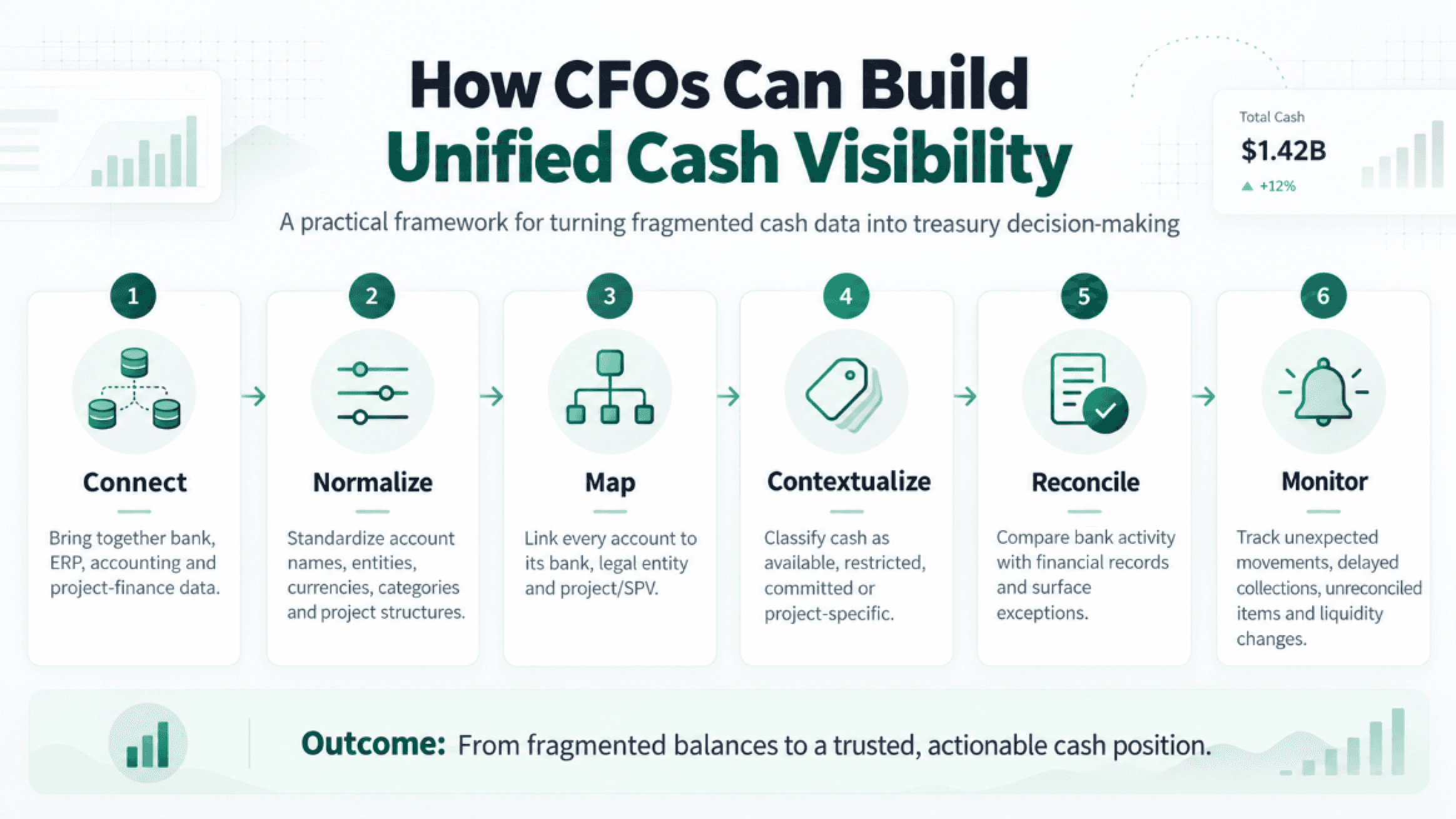
Connect → Normalize → Map → Contextualize → Reconcile → Monitor → Forecast → Act
The goal is not simply to generate more financial information. It is to make existing information easier for finance leaders to trust, understand and act on.
Where ZenBank fits
ZenBank is Zenalyst’s AI-powered enterprise treasury platform, designed to help finance teams improve bank and entity visibility, cash-flow intelligence, transaction understanding, reconciliation, forecasting, monitoring and treasury decision-making.
Rather than viewing treasury information across disconnected systems, ZenBank is designed to help finance teams move toward a more unified operating view of where cash is, what it represents, what changed, what may happen next and where attention is required.
Actual data-update frequency depends on the relevant banking, ERP and system integrations, so organizations should evaluate what “real-time” means within their specific treasury architecture.
For CFOs managing multiple banks, entities and projects, the objective is simple:
Move from knowing the bank balance to understanding the cash position.
That is the foundation of better treasury decisions.